Program
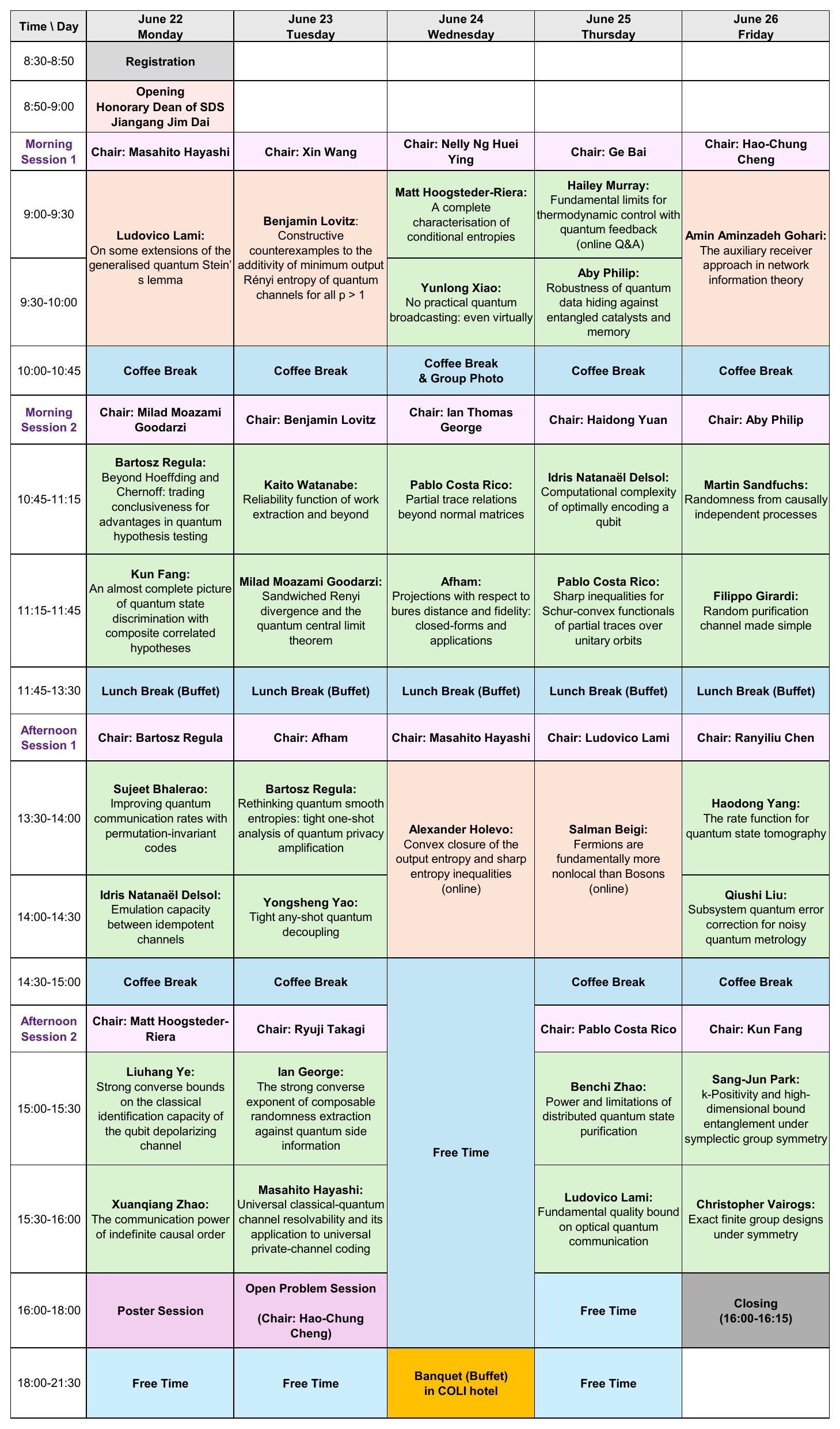
Schedule at a Glance
A PDF version of the complete program is available here: view the complete program (PDF).
Invited Speakers
-
Ludovico Lami (click for more details)
Affiliation: Scuola Normale SuperioreTitle: On some extensions of the generalised quantum Stein’s lemmaAbstractThe recent proofs of the generalised Stein’s lemma have introduced new techniques in quantum hypothesis testing, naturally raising the question of which further extensions these methods make possible. In this talk, I will review some of these developments, focusing in particular on the composite i.i.d. extension established in [Lami/Regula/Takagi, arXiv:2605.15174]. This result shows that, in quantum resource testing with a composite i.i.d. null hypothesis, the resulting Stein exponent is equal to the minimum of the corresponding individual Stein exponents. As a consequence, quantum resources can be transformed via asymptotically resource non-generating operations not only reversibly, but also universally: that is, through protocols that are agnostic to the input state.BiographyLudovico Lami graduated in physics from Scuola Normale Superiore in Pisa, Italy, in 2015, and earned his PhD from the Autonomous University of Barcelona, Spain, in 2017, under the supervision of Andreas Winter. He was an Alexander von Humboldt Research Fellow at the University of Ulm, Germany, from 2020 to 2022, and an Assistant Professor at the University of Amsterdam and QuSoft from 2022 to 2024. He is currently an Assistant Professor at Scuola Normale Superiore. In 2024, he was awarded an ERC Starting Grant. His research interests include quantum information, entanglement theory, quantum Shannon theory, and foundational aspects of quantum physics. -
Benjamin Lovitz (click for more details)
Affiliation: Concordia UniversityTitle: Constructive counterexamples to the additivity of minimum output Rényi entropy of quantum channels for all p > 1AbstractThe classical capacity of a quantum channel is defined as the asymptotic number of bits per channel use that can be sent over that channel. By a theorem of Holevo, Schumacher and Westmoreland, the classical capacity is equal to the regularized Holevo capacity of the channel. It is known that the regularization is necessary, i.e. there exist channels for which the classical capacity is not equal to the one-shot Holevo capacity. This is due to a randomized construction given in [Hastings 09]. It is an open question to derandomize Hastings’ construction. For this, it would suffice to find an explicit channel for which the minimum output entropy is strictly subadditive under the tensor product [Shor 04]. We make progress towards this goal by presenting explicit channels with strictly sub-additive minimum output Rényi entropy for all p > 1, improving upon prior constructions which handled p > 2. Our example is provided by explicit constructions of linear subspaces with high geometric measure of entanglement. This construction applies in both the bipartite and multipartite settings. As further applications, we use our construction to find entanglement witnesses with many highly negative eigenvalues, and to construct entangled mixed states that remain entangled after perturbation. This talk is based on joint work with Harm Derksen (arXiv:2510.07547).BiographyBen Lovitz is an assistant professor in the Department of Computer Science and Software Engineering at Concordia University. He completed his PhD at the University of Waterloo under the supervision of William Slofstra and John Watrous, and was a postdoctoral fellow with Harm Derksen at Northeastern University. His research lies at the intersection of quantum information theory, tensor decompositions, and optimization. He is generously supported by an NSERC Discovery Grant. -
Alexander Holevo (click for more details)
Affiliation: Steklov Mathematical InstituteTitle: Convex closure of the output entropy and sharp entropy inequalitiesDelivery: OnlineAbstractA number of optimization problems in quantum information theory — (one-shot) constrained classical capacity of a quantum channel; entanglement of formation of a composite state; classical capacity of a quantum observable; accessible information of an ensemble of quantum states — can be formulated as calculation of the convex closure of the output entropy of certain quantum channel. This is a convex programming problem for which the dual problem along with the necessary and sufficient optimality conditions can be established. These optimality conditions imply new sharp lower bounds for Shannon entropy which are related to generalizations of the famous log-Sobolev inequality.BiographyAlexander S. Holevo graduated from the Moscow Institute of Physics and Technology in 1966. Since 1969 he works in the Steklov Mathematical Institute, Moscow. Corresponding member of Russian Academy of Sciences — 2016, Full member — 2019. Scientific interests: mathematical theory of quantum communication channels; coding theorems of quantum information theory; noncommutative statistical decision theory; the structure of quantum Markov processes and semigroups. List of publications contains nearly 250 titles including the monographs: "Probabilistic and statistical aspects of quantum theory", "Statistical structure of quantum theory", "Quantum systems, channels, information". Awards: A.A. Markov Prize for the works on the noncommutative probability theory — 1997; International Quantum Communication Award — 1996; A. von Humboldt Research Award — 1999; Claude E. Shannon Award 2016; Sber Science Award — 2022. Invited speaker at the International Congresses of Mathematicians — Berkeley (1986), Madrid (2006), and many other international and national conferences. -
Salman Beigi (click for more details)
Affiliation: Institute for Research in Fundamental Sciences, TehranTitle: Fermions are fundamentally more nonlocal than BosonsDelivery: OnlineAbstractBell’s theorem shows that entangled quantum particles can exhibit correlations that classical particles cannot reproduce without an additional nonlocal resource, such as communication. In this sense, quantum particles are fundamentally more nonlocal than classical ones, and entanglement becomes unavoidable in physics. In this talk an analogous result within quantum theory itself is presented: indistinguishable fermions transmitted through a quantum network can generate correlations that distinguishable particles or indistinguishable bosons cannot reproduce without additional communication. In the same sense, fermions are fundamentally more nonlocal than bosons or distinguishable particles, motivating fermionic anticommutation and indistinguishability as unavoidable operational resources. This result further implies that fermions can strictly surpass all qubit-based protocols for certain distributed computing tasks, demonstrating that a complete understanding of information processing requires going beyond qubits to fermionic information carriers—febits.BiographySalman Beigi received the Ph.D. degree in applied mathematics from Massachusetts Institute of Technology in 2009. He is currently a Full Professor with the School of Mathematics, Institute for Research in Fundamental Sciences (IPM), Tehran, Iran. His research interests include quantum information theory, particularly quantum Shannon theory, quantum algorithms, and foundations of quantum physics. -
Amin Aminzadeh Gohari (click for more details)
Affiliation: The Chinese University of Hong KongTitle: The Auxiliary Receiver Approach in Network Information TheoryAbstractIn this talk, I will discuss recent advancements in the auxiliary receiver approach. This approach serves as a mathematical tool for deriving outer bounds in network information theory. It has proven to be highly effective, providing state-of-the-art outer bounds for a variety of settings in network information theory, including relay channels, interference channels, broadcast channels, key agreement, distributed hypothesis testing, and more.BiographyAmin Gohari received his B.Sc. degree from Sharif University, Iran, in 2004 and his Ph.D. degree in electrical engineering from the University of California, Berkeley in 2010. Dr. Gohari received the 2010 Eli Jury Award from UC Berkeley's Department of Electrical Engineering and Computer Sciences for “outstanding achievement in the area of communication networks,” and the 2009-2010 Bernard Friedman Memorial Prize in Applied Mathematics from UC Berkeley's Department of Mathematics for “demonstrated ability to do research in applied mathematics.” He also received the Gold Medal from the 41st International Mathematical Olympiad (IMO 2000) and the First Prize from the 9th International Mathematical Competition for University Students (IMC 2002). He received the IEEE Iran Section Young Researcher Award in 2021. Dr. Gohari served as an Associate Editor for the IEEE Transactions on Information Theory from 2018-2021. He was also a finalist for the IEEE Jack Keil Wolf ISIT Student Paper Award for three consecutive years from 2008-2010 during his PhD.
Program
Monday, June 22
| Time / Session | Program Details |
|---|---|
| 08:30-08:50 | Registration |
| 08:50-09:00 | Opening (Jiangang Jim Dai, Honorary Dean of SDS) |
| Morning Session 1 | Chair: Masahito Hayashi |
| 09:00-10:00 | Ludovico Lami: On some extensions of the generalised quantum Stein’s lemma (Click here for PDF) |
| 10:00-10:45 | Coffee Break |
| Morning Session 2 | Chair: Milad Moazami Goodarzi |
| 10:45-11:15 | Bartosz Regula: Beyond Hoeffding and Chernoff: trading conclusiveness for advantages in quantum hypothesis testing (Click here for PDF) |
| 11:15-11:45 | Kun Fang: An almost complete picture of quantum state discrimination with composite correlated hypotheses (Click here for PDF) |
| 11:45-13:30 | Lunch Break (Buffet) |
| Afternoon Session 1 | Chair: Bartosz Regula |
| 13:30-14:00 | Sujeet Bhalerao: Improving quantum communication rates with permutation-invariant codes |
| 14:00-14:30 | Idris Natanaël Delsol: Emulation capacity between idempotent channels (Click here for PDF) |
| 14:30-15:00 | Coffee Break |
| Afternoon Session 2 | Chair: Matt Hoogsteder-Riera |
| 15:00-15:30 | Liuhang Ye: Strong converse bounds on the classical identification capacity of the qubit depolarizing channel (Click here for PDF) |
| 15:30-16:00 | Xuanqiang Zhao: The communication power of indefinite causal order (Click here for PDF) |
| 16:00-18:00 | Poster Session |
Tuesday, June 23
| Time / Session | Program Details |
|---|---|
| Morning Session 1 | Chair: Xin Wang |
| 09:00-10:00 | Benjamin Lovitz: Constructive counterexamples to the additivity of minimum output Rényi entropy of quantum channels for all p > 1 (Click here for PDF) |
| 10:00-10:45 | Coffee Break |
| Morning Session 2 | Chair: Benjamin Lovitz |
| 10:45-11:15 | Kaito Watanabe: Reliability function of work extraction and beyond (Click here for PDF) |
| 11:15-11:45 | Milad Moazami Goodarzi: Sandwiched Rényi divergence and the quantum central limit theorem |
| 11:45-13:30 | Lunch Break (Buffet) |
| Afternoon Session 1 | Chair: Afham |
| 13:30-14:00 | Bartosz Regula: Rethinking quantum smooth entropies: tight one-shot analysis of quantum privacy amplification (Click here for PDF) |
| 14:00-14:30 | Yongsheng Yao: Tight any-shot quantum decoupling (Click here for PDF) |
| 14:30-15:00 | Coffee Break |
| Afternoon Session 2 | Chair: Ryuji Takagi |
| 15:00-15:30 | Ian George: The strong converse exponent of composable randomness extraction against quantum side information |
| 15:30-16:00 | Masahito Hayashi: Universal classical-quantum channel resolvability and its application to universal private-channel coding (Click here for PDF) |
| 16:00-18:00 | Open Problem Session (Chair: Hao-Chung Cheng) (Click here for PDF) |
Wednesday, June 24
| Time / Session | Program Details |
|---|---|
| Morning Session 1 | Chair: Nelly Ng Huei Ying |
| 09:00-09:30 | Matt Hoogsteder-Riera: A complete characterisation of conditional entropies |
| 09:30-10:00 | Yunlong Xiao: No practical quantum broadcasting: even virtually |
| 10:00-10:45 | Coffee Break & Group Photo |
| Morning Session 2 | Chair: Ian Thomas George |
| 10:45-11:15 | Pablo Costa Rico: Partial trace relations beyond normal matrices (Click here for PDF) |
| 11:15-11:45 | Afham: Projections with respect to Bures distance and fidelity: closed-forms and applications |
| 11:45-13:30 | Lunch Break (Buffet) |
| Afternoon Session 1 | Chair: Masahito Hayashi |
| 13:30-14:30 | Alexander Holevo: Convex closure of the output entropy and sharp entropy inequalities (online) (Click here for PDF) |
| 14:30-18:00 | Free Time |
| 18:00-21:30 | Banquet (Buffet) in COLI hotel |
Banquet venue details
- English address: The COLI Hotel Shenzhen, No. 168 Dayun Road, Longgang, Shenzhen, China
- Chinese address: 深圳中海凯骊酒店,中国深圳市龙岗区大运路168号
- Navigation: Refer to Amap; see also Venue & Travel
Thursday, June 25
| Time / Session | Program Details |
|---|---|
| Morning Session 1 | Chair: Ge Bai |
| 09:00-09:30 | Hailey Murray: Fundamental limits for thermodynamic control with quantum feedback (online Q&A) |
| 09:30-10:00 | Aby Philip: Robustness of quantum data hiding against entangled catalysts and memory (Click here for PDF) |
| 10:00-10:45 | Coffee Break |
| Morning Session 2 | Chair: Haidong Yuan |
| 10:45-11:15 | Idris Natanaël Delsol: Computational complexity of optimally encoding a qubit (Click here for PDF) |
| 11:15-11:45 | Pablo Costa Rico: Sharp inequalities for Schur-convex functionals of partial traces over unitary orbits |
| 11:45-13:30 | Lunch Break (Buffet) |
| Afternoon Session 1 | Chair: Ludovico Lami |
| 13:30-14:30 | Salman Beigi: Fermions are fundamentally more nonlocal than Bosons (online) |
| 14:30-15:00 | Coffee Break |
| Afternoon Session 2 | Chair: Pablo Costa Rico |
| 15:00-15:30 | Benchi Zhao: Power and limitations of distributed quantum state purification (Click here for PDF) |
| 15:30-16:00 | Ludovico Lami: Fundamental quality bound on optical quantum communication (Click here for PDF) |
Friday, June 26
| Time / Session | Program Details |
|---|---|
| Morning Session 1 | Chair: Hao-Chung Cheng |
| 09:00-10:00 | Amin Aminzadeh Gohari: The auxiliary receiver approach in network information theory (Click here for PDF) |
| 10:00-10:45 | Coffee Break |
| Morning Session 2 | Chair: Aby Philip |
| 10:45-11:15 | Martin Sandfuchs: Randomness from causally independent processes (Click here for PDF) |
| 11:15-11:45 | Filippo Girardi: Random purification channel made simple (Click here for PDF) |
| 11:45-13:30 | Lunch Break (Buffet) |
| Afternoon Session 1 | Chair: Ranyiliu Chen |
| 13:30-14:00 | Haodong Yang: The rate function for quantum state tomography (Click here for PDF) |
| 14:00-14:30 | Qiushi Liu: Subsystem quantum error correction for noisy quantum metrology (Click here for PDF) |
| 14:30-15:00 | Coffee Break |
| Afternoon Session 2 | Chair: Kun Fang |
| 15:00-15:30 | Sang-Jun Park: k-Positivity and high-dimensional bound entanglement under symplectic group symmetry (Click here for PDF) |
| 15:30-16:00 | Christopher Vairogs: Exact finite group designs under symmetry (Click here for PDF) |
| 16:00-16:15 | Closing |
Talks Not Presented
- Discriminating idempotent quantum channels (this work will not be presented)
- Uncloneable encryption from decoupling (this work will not be presented)
Confirmed Poster Presentations
- Matthew Simon Tan: Tight contraction rates for primitive quantum channels
- Xia Liu: Dynamic local operations and classical communication for automated entanglement manipulation
- Ziao Tang: Simulation of adjoints and Petz recovery maps for unknown quantum channels
- Po-Chieh Liu: Sharp estimates of quantum covering problems via a novel trace inequality
- Guocheng Zhen: Structure, optimality, and symmetry in shadow unitary inversion
- Ian George: Local distinguishability of multipartite orthogonal quantum states: Generalized and simplified
- Junkai Zeng: Fundamental costs of noise-robust quantum control: Speed limits and complexity
- Ge Bai: Proper and improper mixed states serve as different prior beliefs for quantum state retrodiction
- Andrey Utkin: Tight norm inequalities for zero-sum vectors and their connection to the entropy inequalities
- Mingrui Jing: Programmable open quantum systems
- Dier Tang: Universal feature selection with noisy observations and weak symmetry conditions
- Xiaodie Lin: Quantum metrology under indistinguishable noise
- Lingna Wang: Tight tradeoff relation and optimal measurement for multi-parameter quantum estimation
- Jinshi Fu: Dimension free L1-Poincaré on qubits
- Jiayi Zhao: Distilling unitary operations: A no-go theorem and minimal realization
- Lijun Wang: Quantitative equivalence between hypercontractivity and strong data processing inequality for quantum channels
- Chengkai Zhu: Entanglement cost of bipartite quantum channel discrimination under positive partial transpose operations
- Entong He: Resource quantification for programming low-depth quantum circuits
- Filippo Girardi: Tumula information and doubly minimized Petz Rényi lautum information
- Hailey Murray: Genuine multipartite Rains entanglement
- Jihong Cai: The hidden nature of non-markovianity
- Longyun Chen: Optimal quantum metrology under energy constraints
- Matt Hoogsteder-Riera: Single-letter chain rules for quantum relative entropy
- Peijie Li: Quantum talagrand-type inequalities via variance decay
- Sujeet Bhalerao: Privacy-utility tradeoffs in quantum information processing
- Vishal Singh: Limiting one-way distillable secret key via privacy testing of extendible states
- Xueyuan Hu: Gaussian time-translation covariant operations: structure, implementation, and thermodynamics
- Long Zhao: Improved lower bounds on MLSI constants of depolarizing semigroups via Pimsner-Popa index
- Chenfeng Cao: Sudden death of entanglement, rebirth of magic